David Contreras, owner of DC Roofing of Arizona, has been roofing in Tucson since 2011, and he's the one who walks a Green Valley roof before solar goes on it. The question we're answering is simple: will the roof under your panels last as long as the panels? If it won't, the roof work has to happen first, because once panels are up, getting to the roof means paying your solar company to take them off and put them back. We don't remove or reinstall solar panels ourselves. Our job is to get the roof right before the solar crew shows up. We're licensed, bonded, and insured (ROC #328733), with $1M per occurrence and $2M aggregate in general liability coverage.
Match the Roof's Remaining Life to the Panels
The U.S. Department of Energy says solar panels in residential systems usually last 20 to 25 years, and its homeowner's guide to solar tells people to consider the age of their roof and how long it will be until it needs replacing. That's the whole idea behind solar prep. Here's how it plays out by roof type:
- Tile. The tiles themselves last a long time. The underlayment beneath them is what keeps water out, and it wears out much sooner. If the underlayment is near the end of its life, re-underlaying before solar is the move. That's typically a three-to-five-day job. Our post on what causes tile roof leaks explains why the underlayment matters more than the tile.
- Shingle. In this sun, a 30-year shingle realistically lasts 15 to 20 years. If yours is past the halfway point, it probably won't outlast the panels.
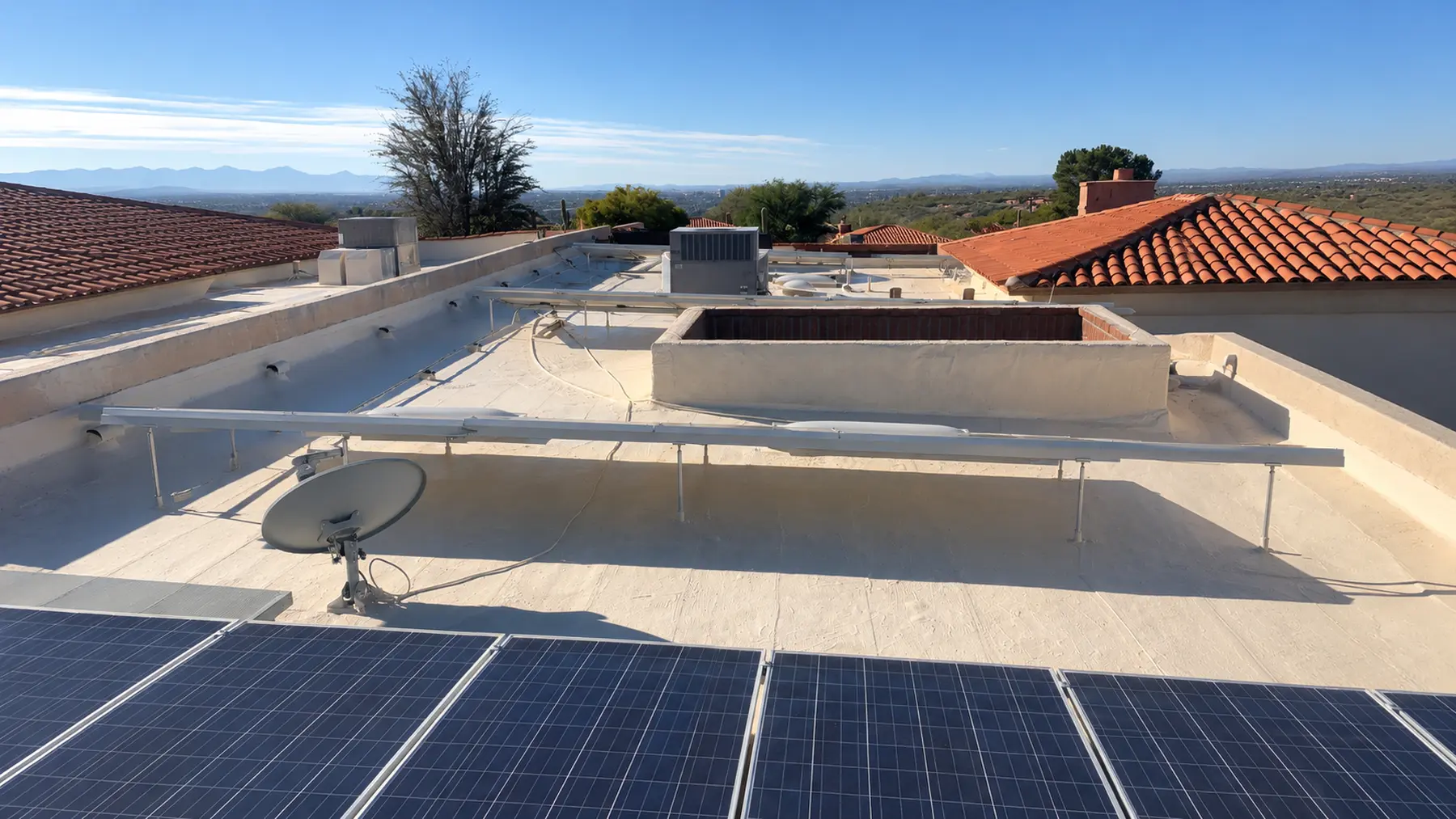
- Flat or foam. A two-coat acrylic elastomeric coating needs a recoat about every five years, and silicone about every 10. Panels sitting on a flat roof make every future recoat harder, so the coating and any repairs should be fresh before racking goes down.
What We Check Before Solar Goes On
David walks the whole roof, with extra attention on the areas where the array will sit:
- Cracked, slipped, or brittle tiles, and the condition of the underlayment where we can see it
- Flashing at walls, vents, and pipes, which is where most roofs leak first
- Soft spots or sagging in the decking
- Old penetrations, like abandoned antenna mounts or cooler curbs, that should be sealed before they end up under a panel
- On flat roofs, the coating, the seams, and which way water drains, so racking doesn't block it
You get a written estimate measured with aerial measurement software, along with an honest call. If the roof is in good shape for another 20-plus years, we'll tell you that and you won't buy anything. If it needs work, we'll show you what and why.
Who Does What
Solar prep goes smoothly when everyone knows their part:
- Your solar company designs the array, handles the permit for the solar system, installs the mounts and panels, and is the one who removes and reinstalls panels if that's ever needed.
- We handle the roof: the inspection, any repairs, re-underlayment, or replacement, done by our own crew with David on site.
If you send us the proposed panel layout, David will check it against what he found on the roof so mounts don't land on a problem area. Ask your solar company who warrants leaks at the mounts after the install, and get it in writing.
Green Valley: Permits and HOAs
Green Valley is unincorporated, so permits go through Pima County. The County's permit list says re-roofing with like materials doesn't need a permit, structural roof work does, and photovoltaic systems do. The solar permit is your solar company's to pull.
Green Valley is made up of dozens of homeowners associations, and people often ask whether theirs can say no to solar. Under Arizona law (A.R.S. 33-1816), an association in a planned community can't prohibit a solar energy device. It can adopt reasonable rules about placement, as long as those rules don't prevent the installation or hurt the system's cost or efficiency. Check your HOA's process before the install date so it doesn't hold up the schedule.
FAQ: Solar Panel Roofing Prep in Green Valley
My roof is about 12 years old. Should I replace it before going solar?
It depends on the roof. A 12-year-old tile roof may have plenty of life left in the tile but not in the underlayment, which is what keeps water out. A 12-year-old shingle roof is likely past the halfway point of its realistic life in this sun. The goal is a roof that lasts as long as the panels, which the Department of Energy puts at 20 to 25 years. A free inspection tells you where yours stands.
Do you remove and reinstall solar panels?
No. Panel removal and reinstallation goes through your solar company. That's exactly why we want to do any roof work before the panels go on, so you never need it.
Can solar go on a tile roof?
Yes, and it's common around Tucson. The mounting takes more care on tile, and the tile around the mounts gets handled during the install. Before that happens, get the underlayment checked, because it's the part that wears out and the hardest part to reach once the panels are up.
Does the roof prep work need a permit in Green Valley?
Green Valley is in unincorporated Pima County. The County's permit list says re-roofing with like materials doesn't need a permit, but structural roof work and photovoltaic systems do. Your solar company handles the solar permit. Rules can change, so we confirm before work starts.
Can my HOA stop me from installing solar?
Under Arizona law (A.R.S. 33-1816), an association in a planned community can't prohibit a solar energy device. It can adopt reasonable rules about placement, as long as they don't prevent the installation or hurt the system's cost or efficiency. Check your HOA's approval process early so it doesn't delay your install.
What if the inspection says my roof is fine?
Then that's what we'll tell you, and you won't owe us anything. The inspection and estimate are free. Plenty of roofs are ready for solar as they are.