
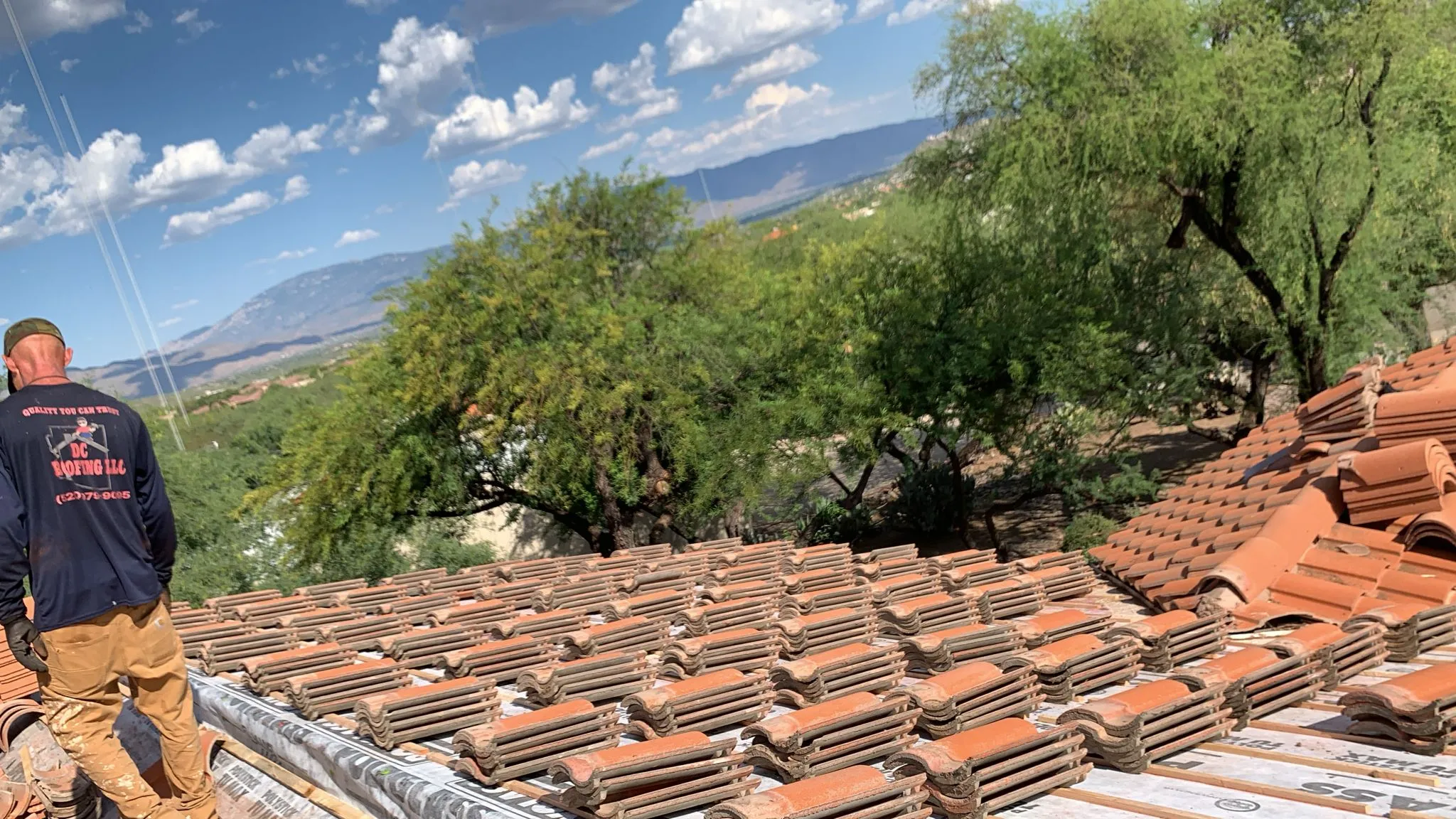
David Contreras, owner of DC Roofing of Arizona, has been roofing in Tucson since 2011, and most of the leaks he gets called out for started small. A cracked pipe boot. A scupper clogged with leaves. A tile that slipped an inch and was never reset. None of those take a roofer to spot. They take someone looking at the right places a couple of times a year.
This post is the homeowner’s half of roof maintenance: what you can check yourself without getting hurt or breaking anything, what to look for on each type of roof, and the well-meant fixes that make leaks worse. When something you find needs a professional, our roof maintenance service covers what we do on a visit.
Start With Safety: Ground, Ladder, Attic
You can learn a lot about your roof without walking on it. In order of how much we recommend them:
- From the ground with binoculars. Walk around the house and look at the roof edges, ridges, and any valleys. You’re looking for anything out of line: a slipped or missing tile, a lifted flashing, a sagging gutter, a dark streak running down from a vent.
- From a ladder at the roof edge. On a flat or low-slope roof, this lets you see the surface, the drains, and the scuppers without stepping onto it. Set the ladder on firm, level ground and have someone hold it.
- From the attic. This is the most useful check most homeowners never do. More on it below.
What we don’t recommend is walking on a tile roof. Concrete and clay tile crack when they’re stepped on in the wrong place, and a perfectly good tile can break under one bad step. Flat roofs are easier to walk on, but they still get slick, and summer surfaces get dangerously hot. Berkeley Lab notes that dark roofs can reach 150°F or more in summer sun.
The Attic Check: The Best Ten Minutes You’ll Spend
Your roof’s underside tells you what the top can’t. Pick a day during or right after a good rain, take a flashlight, and look at:
- The underside of the roof deck, for dark stains, damp spots, or drips
- Around every vent pipe and the evaporative cooler, where the roof has been cut through
- Along the rafters, since water often runs along wood before it drips
- Insulation that looks matted, stained, or compressed in one area
A ceiling stain usually isn’t directly below the hole in the roof. Water can travel a surprising distance along the deck and rafters first, which is why the attic is where you find the real source. If you see active water or fresh staining, call for a roof inspection before the next storm.
What to Look For, by Roof Type
Tile Roofs
Tile is the most common roof we work on, and tile is good at hiding problems. The tile itself mostly sheds water and protects what’s underneath. The underlayment beneath it does the real waterproofing, and it wears out long before the tile does. Our post on what causes tile roof leaks explains this in more detail.
From the ground or a ladder, look for:
- Cracked, slipped, or missing tiles, especially along valleys and edges
- Leaves and debris packed into valleys, which hold water against the underlayment
- Pipe boots around plumbing vents that look cracked or split
- Mortar at ridges and hips that’s cracked or missing
Flat, Foam, and Coated Roofs
Flat roofs fail at the edges and the details, not usually in the middle. From a ladder, look for:
- Scuppers and drains clogged with leaves, nests, or debris. When they’re blocked, water has nowhere to go.
- Water still standing 48 hours after rain. Roofing manufacturers treat that as ponding, and it wears coatings and membranes faster in that spot.
- A coating worn thin. On a foam roof, tan or orange foam showing through the white coating means it’s due for a recoat. Around Tucson, foam gets recoated with acrylic elastomeric, and two coats typically last about five years. Our post on roof coating benefits covers what a recoat does.
- Blisters, cracks, or small pecked holes, especially around the evaporative cooler and along parapet walls.
Shingle Roofs
Shingles take a beating in this sun. Look for shingles that are curling or cupping, bare patches where the granules have worn off, and a lot of granules collecting in gutters or at the bottom of downspouts. Those are signs the shingles are near the end of their life.
Your Evaporative Cooler Is Part of the Roof
If you have a roof-mounted evaporative cooler, the spot where it sits is one of the most common leak sources we see on Tucson-area roofs. The roof is cut open for the duct, the curb takes vibration and weight every summer, and water runs around it.
You’re probably already climbing up there in spring and fall to switch the cooler over or service it. Use that trip. Look at the base of the cooler and the curb under it for cracked sealant, rust, standing water, or a soft feel to the roof around it. Report anything you see to whoever services the cooler and to your roofer.
Mistakes That Make Roof Problems Worse
Most of these come from trying to help:
- Power washing a tile roof. High-pressure water can be forced under the tiles into the underlayment, and it can crack or loosen tile. A garden hose to clear debris is plenty.
- Smearing roof cement on everything. Asphalt roof cement isn’t compatible with EPDM rubber roofs, and manufacturers warn against it. On tile, a blob of sealant on top rarely reaches the real problem underneath.
- Putting the wrong coating on a coated roof. If your flat roof has a silicone coating, only silicone will stick to it later. An acrylic coating from the hardware store will peel.
- Letting other trades cut into the roof unsupervised. A new vent, satellite dish, or solar rack means new holes. Ask how they’ll be sealed, and call your roofer if you’re not sure.
- Waiting for a ceiling stain. By the time a stain shows up inside, water has usually been getting in for a while.
A Simple Tucson Roof Calendar
Spring (March through May): The most important check of the year. Look over the roof, clear valleys, drains, and scuppers, and do an attic check after a rain if you get one. Anything you find has time to be fixed before monsoon season starts on June 15. Spring is also the best time for coating work, since coatings need dry weather to cure.
Summer (June 15 through September 30): Monsoon season. Don’t climb on a hot roof. After a big storm, walk around the house and look from the ground for slipped tiles, lifted flashing, and debris, and check the attic. Our post on spotting roof damage after a storm has a step-by-step checklist.
Fall (October through November): See what the season did. Clear the debris the storms left in valleys and drains, and look closely at flat roof coatings and the area around the cooler.
Winter (December through February): Low priority unless you found something in the fall. A good time to book any repairs before spring fills up.
When to Call a Professional
Some things aren’t homeowner jobs. Call a roofer for:
- Any leak you can’t trace to one obvious source
- Anything involving the underlayment, membrane, or flashing
- Recoating a flat or foam roof
- Repairs around skylights, chimneys, or the cooler curb
- A roof you can’t see well enough to judge, or one you shouldn’t be climbing on
Our inspections are free, and David walks the roof himself. If a small repair is all you need, that’s what you’ll hear. Repairs carry a 2-year labor warranty, and every project we complete includes free annual inspections afterward, which takes care of the professional half of maintenance for you.
Frequently Asked Questions
Is it safe to walk on my tile roof to check it?
We’d rather you didn’t. Concrete and clay tile crack when they’re stepped on in the wrong place, and a cracked tile lets water reach the underlayment, which is the layer that actually keeps your house dry. Most of what you need to see is visible from the ground with binoculars, from a ladder at the edge, or from the attic. If something needs a closer look, that’s what a free inspection is for.
What’s the most useful roof check I can do myself?
Go into the attic with a flashlight during or right after a good rain. Look at the underside of the roof deck and along the rafters for dark stains, damp spots, or drips, especially around vent pipes, the evaporative cooler, and where walls meet the roof. Water shows up there long before it shows up on a ceiling.
Can I seal a small roof leak with roof cement or caulk?
It depends on the roof, and the wrong product can make things worse. Asphalt roof cement doesn’t belong on EPDM rubber roofs, and acrylic products won’t bond to a silicone-coated roof. On tile, a dab of sealant on top rarely reaches the actual problem underneath. A temporary patch to get through a storm is understandable, but have the leak properly traced and repaired afterward.
When should I check my roof each year in Tucson?
Twice is ideal: once in spring, before monsoon season starts on June 15, and once in October after it ends on September 30. Add a quick look after any big storm. Spring is the more important of the two, because it gives you time to fix anything before the storms arrive.
How often should a professional look at my roof?
Once a year is a good habit, and more often for older roofs, foam roofs approaching a recoat, or roofs with a history of leaks. Our inspections are free, and every project we complete includes free annual inspections afterward, so there’s no cost reason to skip it.
Should I power wash my roof?
Not a tile roof. High-pressure water can be driven under the tiles and into the underlayment, and it can crack or loosen tile. Coated flat roofs are cleaned as part of a recoat, using the coating manufacturer’s cleaning method. If your roof looks dirty, a garden hose to clear debris is plenty.
If your roof hasn’t had a professional look in a while, now is a good time. DC Roofing of Arizona is licensed, bonded, and insured (ROC #328733), and we offer free roof inspections throughout Tucson and Southern Arizona.