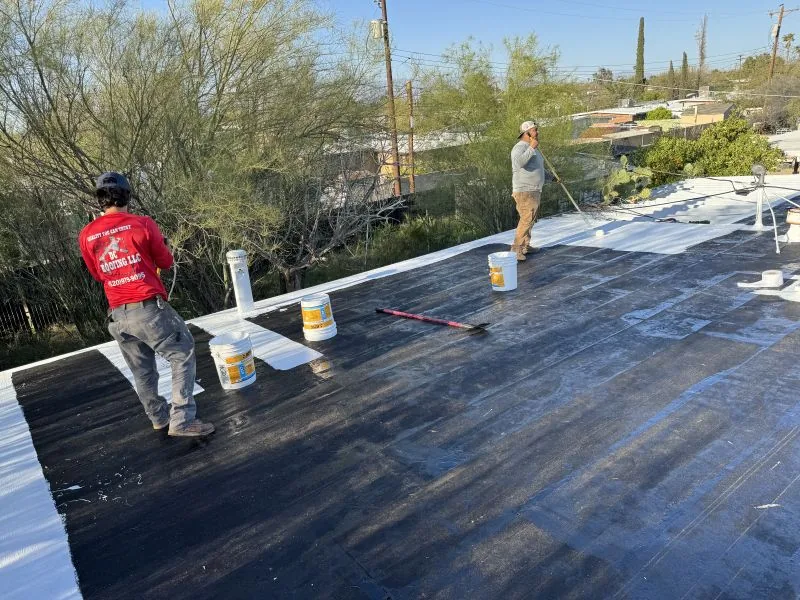
David Contreras, owner of DC Roofing of Arizona, has been roofing in Tucson since 2011, and he walks every Sahuarita roof we quote for a coating. Some people call us about a first silicone coat on an aging flat roof. Others already have a silicone roof, from us or someone else, and it's due again. Those are two different jobs, and this page covers both, plus what you can do between coats to get the most out of one. We're licensed, bonded, and insured (ROC #328733), with $1M per occurrence and $2M aggregate in general liability coverage, and APOC certified for coating work.
A First Coat vs. a Recoat
A first coat goes over whatever the roof has now: foam, an older acrylic coating, a membrane, or a built-up roof. Each of those needs its own prep, and some need a primer before silicone will bond. Most of the decision is whether silicone is the right coating at all. It's the best choice where water sits after storms, and it costs more than an acrylic coating that would do fine on a roof that drains well.
A recoat is narrower. If the roof already has silicone on it, the next coat has to be silicone too. Acrylic and most other coatings won't bond to cured silicone and will peel. So on a recoat, the questions are whether the existing silicone is still well attached and what it takes to get a new coat to stick to it.
How a Silicone Recoat Is Done Right
- Inspect first. David checks where the old coating is still bonded and where it has lifted, split, or worn through. Failed areas get cut out and repaired.
- Clean thoroughly. Silicone collects dirt, and a new coat won't bond to a dirty surface. The roof is washed with the cleaner the coating manufacturer specifies, rinsed, and left to dry completely.
- Test adhesion. Before coating the whole roof, we apply a test patch and check that it grips. This is the step that tells you a recoat will hold, and it's the step cheap jobs skip.
- Repair with silicone only. Seams, penetrations, and cracks are rebuilt with silicone-compatible materials, then the full coat goes on at the thickness the manufacturer specifies.
If the old silicone is peeling over large areas, a recoat on top of it won't hold any better than the coat underneath. At that point the loose coating has to come off, and we'll tell you before you spend money on a coat that can't last.
Keeping a Silicone Roof Working Between Coats
A few habits stretch the time between recoats:
- Keep it clean. A dirty silicone roof reflects less sun. A rinse with plain water helps. If you'd rather not get on the roof, and most people shouldn't, we can look at it during your annual inspection.
- Keep drains and scuppers clear. Silicone tolerates standing water, but debris that blocks a drain still causes problems.
- Watch the penetrations. Cooler curbs, pipes, and anything another trade has mounted on the roof are where coatings fail first.
- Call before another trade works up there. A new vent or a solar rack cut through a coated roof needs to be sealed with silicone-compatible materials.
Signs it's time for a recoat include coating worn thin enough to see the surface underneath, edges lifting at parapets or curbs, and cracking around penetrations. If it was applied correctly, a silicone coating typically lasts about 10 years before it needs another coat.
Timing It Around Monsoon Season
Coatings need dry weather to cure, and monsoon season runs from June 15 through September 30. The best window is spring, when the roof is warm but not scorching and storms aren't rolling in every afternoon. If your coating is failing now, don't wait until the next spring to have it looked at. Driving monsoon rain is hard on a worn coating.
Sahuarita Permits and Paperwork
Sahuarita is an incorporated town with its own Building Safety Division. The Town's permit guidance says replacing roofing material like for like doesn't need a permit, and neither does replacing only the underlayment. Repairs to roof sheathing or structural members do, and some projects need a zoning clearance even when a building permit isn't required. A recoat doesn't touch the structure. If prep uncovers rotted decking, that repair may need a permit, and we'll tell you before work starts.
We don't use salespeople or subcontractors. Our own crew does every coating job, with David on site. Coating work carries a 5-year labor warranty, and every project we complete includes free annual inspections. For more on how silicone compares to other coatings, see our silicone roof coating page, and if you're not sure what your roof needs, a roof inspection is the place to start.
FAQ: Silicone Roof Coating in Sahuarita
My roof was coated with silicone by another company. Can you recoat it?
Yes, as long as the existing silicone is still well attached. We inspect it, cut out and repair failed areas, clean the roof, and test adhesion before recoating with silicone. If the old coating is peeling over large areas, it has to come off first, and we'll tell you that before you pay for a coat that can't hold.
Why can't I put a cheaper acrylic coating over my silicone roof?
Acrylic and most other coatings won't bond to cured silicone. They bead up, then peel, often in sheets. Once a roof has silicone on it, every future recoat and repair has to be silicone.
How do you know a new coat will stick?
We do an adhesion test. After the roof is cleaned and dry, a test patch goes on and we check that it grips before coating the whole roof. It's the step that tells you a recoat will hold.
Can you just fix the bad spots instead of recoating the whole roof?
Often, yes. If most of the coating is sound and a few areas around penetrations or edges have failed, those spots can be repaired with silicone. If the coating is thin across the whole roof, spot repairs only buy a little time and a full recoat is the better value.
When is the best time to recoat a roof in Sahuarita?
Spring. Coatings need dry weather to cure, and monsoon season runs from June 15 through September 30. If your coating is already failing, have it looked at now rather than waiting, because monsoon rain is hard on a worn coating.
Do I need a permit for a roof coating in Sahuarita?
The Town of Sahuarita's guidance says replacing roofing material like for like, or replacing only the underlayment, doesn't need a permit, but repairs to roof sheathing or structural members do. Some projects also need a zoning clearance. A recoat doesn't touch the structure. If we find rotted decking, we'll tell you if that repair needs a permit.
What warranty comes with a silicone coating?
Our coating work carries a 5-year labor warranty, and every project we complete includes free annual inspections. Applied correctly, a silicone coating typically lasts about 10 years.