
Expert Foam Roofing for Tucson & Southern Arizona
Spray polyurethane foam roofing has been the dominant flat-roof system in Tucson for good reason - it's the only system built for what this climate actually throws at a roof. David Contreras, owner of DC Roofing of Arizona, has been installing and restoring SPF systems in Southern Arizona since 2011, and the difference between a properly installed foam roof and a conventional flat-roof system shows up on every utility bill and in how well the roof holds together through monsoon season after monsoon season.
Watch: DC Roofing of Arizona in Action
Why Flat Roofs in Tucson Fail Without the Right System
Most flat roofs in Tucson weren't built to handle what this climate throws at them. They were built fast. That's why we get calls from homeowners near South Tucson and business owners off Broadway who are dealing with leaks they can't seem to fix.
The problem isn't always the roof's age. It's the materials sitting on top of it.
Traditional flat roof systems like single-ply membranes and built-up roofing rely on seams, fasteners, and adhesives to hold everything together. Tucson's thermal cycling destroys those connection points. During summer, your roof surface can hit 170 degrees by afternoon, then drop 50 or 60 degrees overnight. That expansion and contraction happens every day for months. Seams pull apart. Fasteners back out. Adhesive dries and cracks. We see this every week on flat roofs around Tucson that are barely ten years old.
Here's what usually goes wrong first:
- Ponding water collects in low spots where the membrane has shifted or sagged
- UV exposure breaks down unprotected surfaces faster than most people expect
- Evaporative cooler penetrations create weak points that leak during monsoon season
- Flashing around parapet walls separates from the substrate after years of heat stress
Foam roofing solves the seam problem entirely. It's sprayed as a liquid, so it forms one continuous layer across the entire roof deck - achieving R-6 to R-7 insulation value per inch versus R-1 to R-2 for most other flat-roof systems. No seams to fail. No fasteners to back out. It conforms around cooler mounts, vents, and pipe penetrations without relying on caulk or mechanical attachments that deteriorate in our heat.
If you've patched the same flat roof two or three times and the leaks keep coming back, it's probably not a repair problem. It's a system problem. That's the conversation worth having before your next monsoon season rolls in.
How Spray Foam Roofing Handles Desert Conditions
Tucson throws everything at a roof. Triple-digit heat from April through October. UV exposure that's among the harshest in the country. Then monsoon season rolls in with driving rain, hail, and wind gusts that rip loose materials right off. Most roofing systems handle one of those problems well. Foam roofing handles all of them.
Spray polyurethane foam is a closed-cell material. Moisture can't penetrate it the way it does with traditional built-up roofing or single-ply membranes. We see older flat roofs around the Midvale Park area with ponding water after every monsoon storm. That standing water destroys most roof surfaces over time. Foam roofing resists it because there are no seams, no laps, no joints where water can sneak through.
The heat performance is where it really shines. Foam roofing creates a continuous layer of insulation directly on your roof deck, and SPF systems can reduce cooling energy costs by up to 30 percent in hot climates. That's not a small number when your AC runs eight months a year in Tucson. The reflective coating on top bounces solar radiation away instead of absorbing it - we've checked surface temperatures on foam roofs versus traditional flat roofs on the same street, and the difference can be 40 to 50 degrees on a July afternoon.
Thermal cycling is the other big factor people don't think about. Tucson roofs expand in 110-degree daytime heat, then contract when it drops to 75 at night. That constant movement cracks rigid materials and breaks sealant bonds. Foam roofing flexes with those temperature swings instead of fighting them. It stays bonded to the substrate because it moves with the building.
FEMA's technical guidance on foam roofing performance standards for low-slope roofs confirms that spray polyurethane foam systems meet rigorous durability and weather-resistance criteria - exactly the kind of performance that matters on a Tucson flat roof.
Diagnosing Bubbles, Soft Spots, and Coating Wear
Most folks don't climb up on their roof looking for trouble. They call us because something already went wrong inside - a water stain on the ceiling, a musty smell in a back room, maybe an energy bill that jumped and nobody can figure out why.
The foam itself is tough, but the protective coating on top takes a beating from our UV and thermal cycling. That's usually where problems start. Here's what we look for during a foam roofing inspection:
- Bubbles or blisters in the foam surface, often caused by moisture trapped underneath during the original install or a coating failure that let water seep in over time
- Soft or spongy spots where the foam gives under light foot pressure, a sign that water has been sitting and breaking down the material from within
- Exposed or chalky coating where the top layer has worn thin, leaving the foam directly exposed to Tucson's intense sun
- Cracks around penetrations like evaporative cooler mounts, vents, and pipe boots where thermal movement has pulled the seal apart
A bubble doesn't always mean the whole roof is failing. It's a localized issue we can address without tearing everything off. But you have to catch it early - once water gets into the foam and sits there through a few monsoon cycles, the damage spreads fast. We pay close attention to areas around Midvale Park and the south side where older commercial buildings have had foam roofing for decades. Some of those roofs just need a fresh elastomeric coating. Others need sections cut out and resprayed. The only way to know is to get up there and press on it.
David does these inspections himself. No sales reps, no guesswork. We tell you what your roof actually needs. If a recoat handles it, that's what we recommend. We're licensed under ROC #328733, and we don't push work that isn't necessary. Not sure if your foam is still sound? A professional inspection takes the guesswork out of the decision.
Keeping a Foam Roof Performing for Decades in Tucson
Here's what most people don't realize about foam roofing: the foam itself can last 50 years or more - but only if you stay on top of the protective coating that shields it.
That coating is what takes the beating from Tucson's sun, monsoon rain, and dust. Without it, UV rays break down the foam surface. We see this on older homes near the Catalina Foothills and down in the midtown area all the time. The foam starts to turn yellow, then brown, then it gets chalky and pitted. Once that happens, moisture gets in. Moisture in foam means trouble.
The good news is that maintenance on a foam roof is straightforward:
- Get a roof inspection at least once a year, ideally before monsoon season starts in June.
- Clear any debris, dirt buildup, or standing water from low spots after storms.
- Check for bird damage or punctures - these are common around evaporative cooler penetrations.
- Recoat the surface about every five years to renew that UV barrier. Around Tucson, foam gets recoated with two coats of acrylic elastomeric. Silicone is an option where water sits, but after that the roof can only be recoated with silicone.
- Fix small issues immediately. A tiny gouge today becomes a big repair next summer.
Industry records show properly maintained foam roofing systems lasting over 50 years on commercial buildings. That tracks with what we see here in the desert. Each recoat renews that protection for about another five years. Skip it, and you're looking at foam replacement instead of a simple resurface.
David includes a free annual inspection with every foam roofing project we complete. We're licensed under ROC #328733, and we keep records on every roof we touch, so when it's time for a recoat, we already know your roof's history. A foam roof won't ask much of you - just don't ignore it.

David Contreras, Owner & Founder - DC Roofing of Arizona · Licensed ROC #328733 · Tucson native since 1989
Foam Roofing Projects Completed in Tucson
How Our Foam Roofing Process Works
- 1
Surface Prep and Cleaning
We strip off loose debris, old coatings, and anything that won't let the foam bond properly. On older roofs we've pulled up three or four layers of patching before getting to a clean surface. Skipping this step is how foam jobs fail.
- 2
Repair the Substrate
Rotten decking, cracked parapet walls, damaged flashing around evaporative cooler penetrations - all of it gets fixed before any foam goes down. We won't spray over a problem.
- 3
Apply the Polyurethane Foam
Our crew sprays the foam in even passes across the entire roof surface. It expands on contact and fills in low spots, cracks, and seams at 1.5–2 inches thickness. Tucson's dry heat actually helps the foam cure faster in most months.
- 4
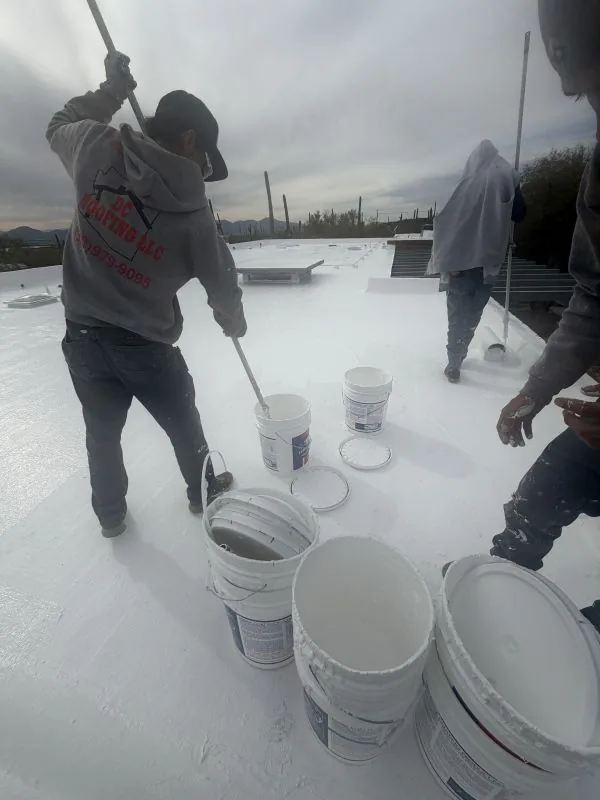
Apply the Protective Coating
Bare foam can't handle UV exposure. We add an elastomeric or silicone coating on top to shield it from the sun. This is what gives the roof its reflective, energy-saving finish and determines the system's longevity.
- 5
Final Inspection and Walkthrough
We walk every inch - check thickness, look for missed spots, confirm all penetrations are sealed tight. David walks the finished roof with you if you want. You see the work with your own eyes before we leave the site.
Ready to Get Started?
Fast response. Licensed ROC #328733. 4.8★ across 100+ Google reviews.
Foam Roofing Services We Provide in Tucson and Southern Arizona
What Tucson Homeowners Gain from Choosing DC Roofing of Arizona
Foam Roofing in Tucson, Oro Valley, Marana, Sahuarita, Green Valley, and Vail
DC Roofing of Arizona provides foam roofing services throughout Southern Arizona, including:
Frequently Asked Questions About Foam Roofing in Tucson
How long does foam roofing actually last on a Tucson flat roof?
A properly maintained foam roof in Tucson can last decades. The foam itself doesn't have the seams, fasteners, or adhesive joints that fail on traditional flat roofs. The key is recoating the protective top layer about every five years. That coating shields the foam from UV exposure. Skip that step and the foam degrades faster. Stay on top of it and you've got a roof system that outlasts most conventional options in this climate.
Will foam roofing hold up through Tucson's monsoon season?
Yes, foam roofing handles monsoon conditions better than most flat roof systems. Because it's sprayed as one continuous layer, there are no seams or laps where water sneaks through during heavy rain. Evaporative cooler penetrations and parapet wall flashings - two spots that leak constantly on older Tucson roofs - get sealed tight during installation. Driving rain and wind gusts that rip loose materials off traditional roofs don't affect a properly coated foam system the same way.
Can foam roofing be installed over my existing flat roof, or does the old material have to come off?
In many cases, foam can be sprayed directly over an existing flat roof without a full tear-off. But the surface has to be clean, dry, and solidly bonded. We've pulled up three or four layers of old patching on roofs around Tucson before finding a surface the foam can actually bond to. If the decking underneath is rotten or the existing layers are saturated, those problems get fixed first. Spraying over a bad substrate is how foam jobs fail early.
How much can foam roofing actually cut my cooling costs in Tucson?
SPF roofing systems can reduce cooling energy costs by up to 30 percent in hot climates like Tucson. That's a real number when your AC runs eight months a year. The foam adds R-6 to R-7 insulation per inch directly on the roof deck, and the reflective coating on top bounces solar radiation away instead of absorbing it. We've measured surface temperature differences of 40 to 50 degrees between foam roofs and traditional flat roofs on the same street on a July afternoon.
How long does the foam roofing installation take, and do I need to leave my home?
Most residential flat roofs in Tucson take two to four days from start to finish. You don't need to leave your home, but there will be noise and some odor during the spray application. The foam and coating need time to cure between passes, so the crew may be on and off the roof over multiple days. Dry summer days are actually ideal conditions for a fast, clean cure.
If I've already patched my flat roof multiple times, is foam roofing still an option?
Yes, and it's often exactly the right move. If you've patched the same roof two or three times and leaks keep coming back, the patching isn't failing - the system underneath is. Traditional flat roof materials rely on seams and adhesives that Tucson's thermal cycling destroys over time. Foam roofing replaces that whole approach with one seamless layer. We see this situation regularly on flat roofs around South Tucson and the Broadway corridor. Repeated patching is usually a sign it's time to change the system entirely.
How much does foam roofing cost in Tucson?
New foam roof installation in Tucson typically runs $4–$8 per square foot installed, including foam and topcoat. A 2,000 sq ft flat roof runs approximately $8,000–$16,000. Foam recoating (refreshing the topcoat on an existing foam roof) costs significantly less - typically $1.50–$3.50 per square foot. DC Roofing of Arizona provides free written estimates at (520) 979-9095.
Is foam roofing good for solar panels in Tucson?
Yes - foam roofing is an excellent base for solar panel installation in Tucson. The seamless surface eliminates seam penetration concerns, and the high insulation value adds to the overall energy efficiency of a solar installation. Before solar goes on, we verify the foam and coating are in good condition and properly treat any penetrations for the mounting hardware.