David Contreras, owner of DC Roofing of Arizona, has been roofing in Tucson since 2011, and he walks every Marana roof we estimate, residential or commercial. EPDM is a synthetic rubber membrane, and it covers a lot of low-slope roofs: shops, small commercial buildings, additions, and flat sections on homes. Whether you own the building or manage it for someone else, the decisions are the same. How is the roof held down, how thick is it, is it worth repairing, and if not, what goes on next? We're licensed, bonded, and insured (ROC #328733), with $1M per occurrence and $2M aggregate in general liability coverage, and we handle both residential and commercial roofing.
Three Ways an EPDM Roof Is Held Down
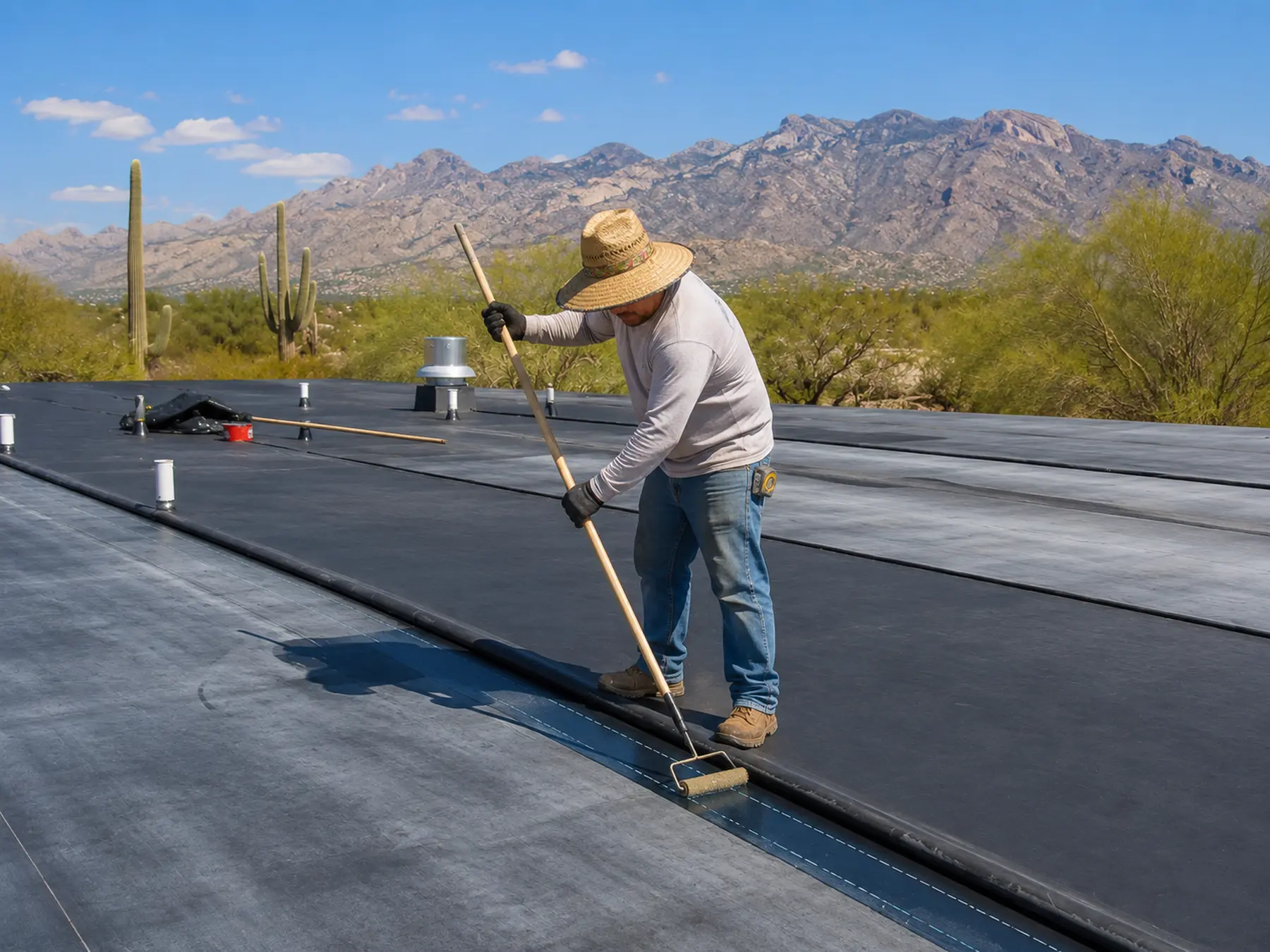
Before anyone can repair or replace an EPDM roof properly, they need to know how it was attached. The EPDM Roofing Association describes three systems:
- Fully adhered: the membrane is glued to insulation or cover board that's fastened to the deck. No rock on top, and the sheet sits tight and flat.
- Mechanically attached: the membrane is fastened to the deck with plates or batten strips, usually along the seams.
- Ballasted: the membrane is laid loose and held down by the weight of river rock or pavers.
Each one fails differently. On a ballasted roof, the rock has to be moved to find the leak, and the weight has to be accounted for on the structure. On a mechanically attached roof, wind can work fasteners loose over time and lift the sheet between them. On an adhered roof, the problems are usually seams and edges. Monsoon gusts matter here, because wind gets under any loose edge. When we replace a roof, David picks the attachment method based on the deck, the building, and its wind exposure.
Thickness and Seams
EPDM comes in 45, 60, and 90 mil sheets. Thicker membrane takes foot traffic and abuse better, which matters on a commercial roof where HVAC techs walk to the units every few months. A roof with almost no traffic doesn't need the heaviest sheet, and David will tell you so.
Seams are where EPDM roofs are won or lost. Older roofs were seamed with contact cement, and years of daily heating and cooling can loosen it. Modern EPDM seams are primed and taped, then rolled tight. EPDM can't be heat-welded, so if you're comparing bids and someone describes welding the seams of an EPDM roof, they're describing a different product or the wrong method.
Black Rubber, Desert Sun, and the TPO Question
Most EPDM is black, and the EPDM Roofing Association explains why: carbon black in the rubber protects it from UV by converting the sun's rays into heat. That's an advantage in cold climates and a cost here, where a dark roof absorbs heat all afternoon. White EPDM exists, and a reflective coating can go over sound black EPDM after the right cleaning and primer.
When an EPDM roof is at the end of its life, many owners switch to white TPO for the reflectivity. Others stay with EPDM because it suits the budget or the building. We price both so you can make that call with real numbers. Our EPDM roofing page and TPO roofing page lay out the differences.
Permits in Marana
Marana is an incorporated town, so permits go through the Town, not Pima County. The Town of Marana's permit guidance says replacing roofing material like for like doesn't need a permit, and neither does replacing only the underlayment. Repairs to roof sheathing or structural members do. On an old flat roof, a tear-off sometimes turns up rotted decking, which is exactly the situation that triggers a permit. We'll tell you before work starts if your project is likely to need one, and requirements can change, so it's worth confirming with the Town.
Working With Owners and Property Managers
On a commercial building, the person who calls us often isn't the person who signs off. That's fine. You get a written estimate measured with aerial measurement software, so the numbers match the roof, and a plain explanation you can pass along. There's no salesperson in the middle: the person who walks the roof is the person responsible for the work. David is on site for the job, our own crew does it, and the site gets cleaned up daily. Repairs carry a 2-year labor warranty, flat roof replacements carry a 5-year labor warranty, and every project we complete includes free annual inspections, which is an easy way to keep a building's roof on a schedule.
FAQ: EPDM Roofing in Marana
How do I know if my EPDM roof is ballasted, adhered, or mechanically attached?
If there's river rock or pavers on top, it's ballasted. If the sheet is smooth and tight with no rock, it's usually adhered. If you see rows of slight bumps or the sheet lifts between lines of fasteners in the wind, it's likely mechanically attached. We confirm it during the inspection, because it changes how the roof is repaired.
Can you repair part of an EPDM roof without replacing the whole thing?
Yes, when the rest of the membrane is sound. Seam failures, flashing problems, and punctures are repaired with EPDM-compatible primer, tape, and membrane. If the rubber is brittle or seams are failing all over the roof, patching becomes a cycle and replacement is the better spend. We'll tell you which one you're looking at.
What thickness of EPDM should my building have?
EPDM comes in 45, 60, and 90 mil. Roofs with regular foot traffic, like commercial buildings with HVAC units that get serviced, are better off with a thicker sheet. A roof that almost nobody walks on doesn't need the heaviest option. David recommends a thickness based on how the roof is actually used.
Do I need a permit to replace an EPDM roof in Marana?
Marana's permit guidance says replacing roofing material like for like, or replacing only the underlayment, doesn't need a permit. Repairs to roof sheathing or structural members do. If a tear-off turns up rotted decking, that part of the job needs one. Requirements can change, so we confirm with the Town before work starts.
Should I switch from EPDM to TPO when I replace my roof?
Many owners do, because white TPO reflects much more sun than black EPDM and its seams are heat-welded. EPDM can still make sense for some budgets and buildings. We price both so you can compare them on your actual roof.
Can you put a coating over our EPDM roof instead of replacing it?
If the membrane is well attached and the insulation underneath is dry, a reflective coating can extend its life. EPDM needs a specific cleaning and primer step before a coating will bond, and we test adhesion first. A two-coat acrylic elastomeric coating typically lasts about five years before a recoat, silicone about 10, and our coating work carries a 5-year labor warranty.
Do you work on commercial buildings in Marana?
Yes. We handle residential and commercial roofing, including flat roof repair, coatings, and replacement. David walks every roof himself and gives you a written estimate.